Outside Looking In · Vol. 01
Outside
Looking In
Some of the best work professionals create never survives an interview process. This series exists to give those ideas a longer life.
Context
Why I'm Sharing This
This presentation was never requested. There was no take-home assignment. Nobody asked for a strategy deck.
I simply believed that if I wanted to stand out, I should not only explain my experience — I should demonstrate how I think.
So I built one.
Not because I expected it to get me hired. Because I believed having a point of view mattered.
"I believe it is better to express a perspective than to have no perspective at all."
— Alex Feder
the resilience to persevere,
the confidence to advocate,
the humility to adapt.
— Alex Feder
The Presentation
UX Design Agencies Program Lead
A Point of View — Program Vision, Reflections on Role
Purpose
The purpose of this document is to express a perspective. It is a point of view from the outside, looking in.
I believe it is better to express a perspective than to have no perspective at all. To this end, my hope is that there is value to be gleaned from within this document that can be of use to you, your department, the program, and the person ultimately selected for the role.
Department Ethos
Six principles that should govern how a UX design organization operates, thinks, and delivers.
- 1Advocate for the user
- 2Listen to opposition
- 3Collaborate to problem-solve
- 4Lead with curiosity, humility, and empathy
- 5Drive a culture of user-centered development
- 6Set the bar for quality, usability, and simplicity
Program Objectives
Six operating commitments that define how a program lead should approach the role.
- 1Build programs that scale
- 2Drive continuous improvement
- 3Deliver flawlessly, in concert with cross-discipline leads
- 4Communicate up, down, and across
- 5Cultivate departmental growth
- 6Be the voice of the user
Agency Partner Strategy
Today's organizations maintain a portfolio of agency partners to meet their business objectives. The mix diversifies the portfolio and looks to maximize return as a result, much like an investment portfolio. Diversification means contrasting characteristics of the agencies.
Three dichotomies emerge. Strength in one aspect typically comes at the expense of another.
Breadth v. Depth
Over the last 15 years, organizations have moved away from one-stop-shops and look to a portfolio of partners to meet their needs. Agencies which boast breadth commonly lack depth across the offering. Smaller, specialized agencies are common depending on organizational needs and priorities.
Scale v. Agility
Small-to-midsize partners — those employing fewer than 300 — are nimble. Most are private, giving their leadership latitude to make timely, unilateral business decisions. Teams are leaner. Cross-functional leads act as generalists. However, small partners have difficulty with scale.
Strategy v. Production
The ability to plan strategically can come at the expense of a capacity to execute. Commoditized services and specialized activities often need partners which specialize accordingly.
Sourcing Criteria
Performance Metrics
i.e., OKRs
Performance Scorecard (ranked 1–5)
Communication Framework
Program governance and communication is critical to the overall success of the program and alignment within the organization. As part of establishing the Agency Council, the model reflects how the department interacts with the broader organization.
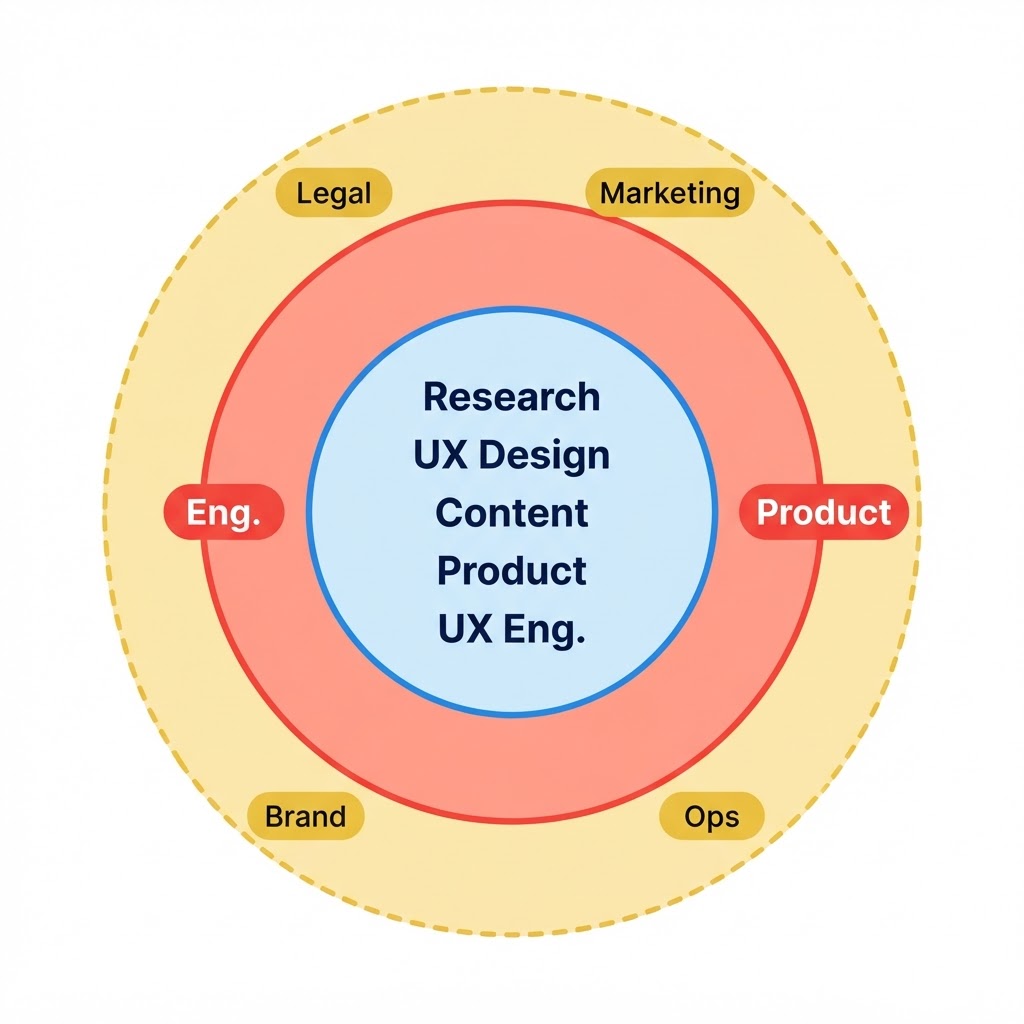
Lifecycle Blueprint
Partners take on different roles and responsibilities based on the phase in the project lifecycle. This blueprint determines how agency partners should operate depending on their services and the phase in which they are engaged.
| Discipline | Relate | Illustrate | Create | Elaborate |
|---|---|---|---|---|
| Research | Participant screening & recruitment, develop user panel, category audit | Quantitative surveys, qualitative interviews, card-sorting, scenario validation, low-fidelity prototype testing | Iterative usability testing | Continued test & learn research |
| UX Design | Current state journeys, category design audit | Personas, primary usage scenarios, design vision / creative territory, entry-point strategy, journey mapping, UX/design system components, visual language | User flows, wireframes / experience design, interaction / animations | Continued test & learn, iterative UX development |
| Product | Review of secondary research, product category audit | Product strategy / jobs to be done, primary product requirements, MVP prioritization, high-level product roadmap | Sprint planning, backlog maintenance / grooming, demos / feature feedback | Iterative feature / backlog and roadmap prioritization |
| Content | Review of secondary research, category content audit | Communications framework, channel / engagement strategy, content calendar | UI copywriting, visual QA | Continued test & learn, iterative design development |
| UX Eng. | Review of libraries, process, tools, documentation | Recommendation of libraries, process, tools / documentation, high-fidelity prototyping | Ongoing prototyping, client-side development | Continued test & learn, iterative client-side development |
| Engineering | Audit of current systems, services, architecture | Technology vision and roadmap, systems architecture | Server-side development, APIs and service layer integration, QA | Test & learn activities, iterative development / QA |
A Note
Built Before AI
This presentation was created in May 2022.
Before ChatGPT. Before Claude. Before Gemini.
Every framework. Every diagram. Every operating model. Every slide. Started with a blank page.
Today I would absolutely use AI.
But I would use it to communicate my thinking — not replace it. Original thought remains the differentiator.
Original Document
Download the Original PDF
Interested in seeing the original presentation exactly as it was created in May 2022?